
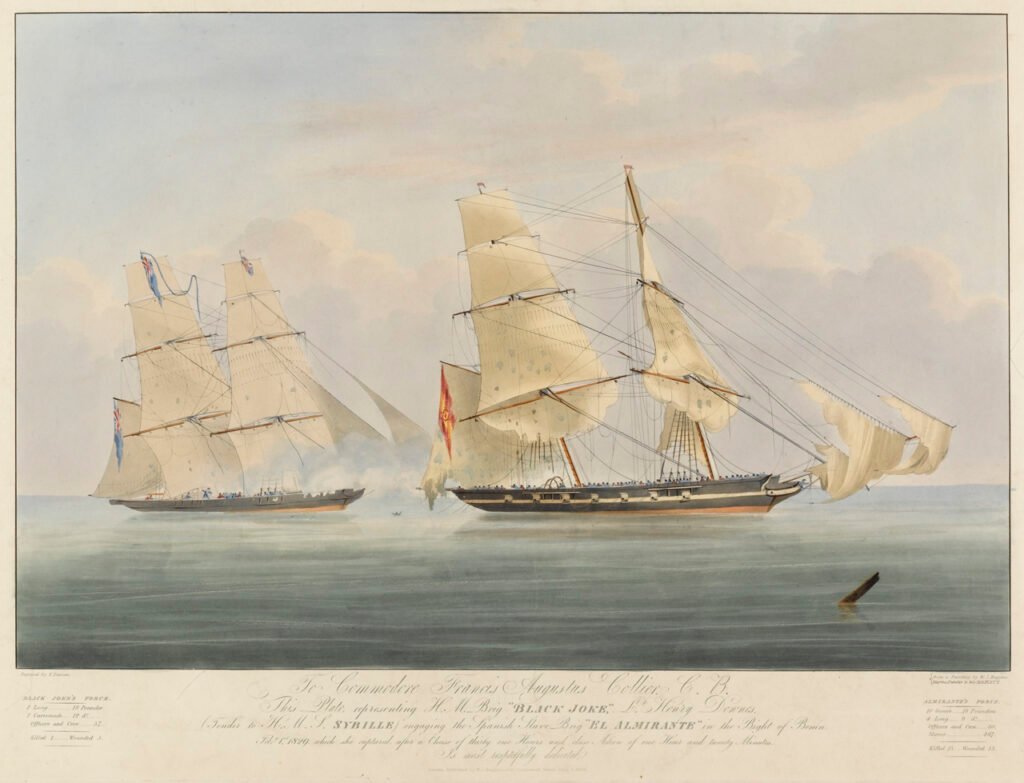
…so I emerge from the fog.
The old oak deck creaks beneath my feet; the air tastes of salt and gunpowder. At the stern, the flag of the Royal Navy flutters, and amid the stars gleams the number of the squadron: West Africa Squadron.
I walk past the guns, hear the whistle of ropes and the bosun’s voice: “Raise the anchor!” — the voyage begins, not for gold, but for people. On the captain’s table lie maps of the coast from Sierra Leone to the Gulf of Guinea. In red ink, the points are marked where merchant vessels still try to smuggle slaves. Beside them lies the logbook, where we will record every decision, every storm, every rescue.
You can feel the paradox in this ship: born of the violence of its age, it became its own redemption. A light frigate that once carried people in chains now hunts those who still do. On the bow someone has carved a motto by hand: “Not for Gold, but for Souls.”
Do you see the horizon? There, under the line of the sun, a silhouette shimmers — a slaver, swift as a shadow. The sails of our Black Joke swell with the wind; there’s a whistle of command, and among us passes that single, taut question:
Will we reach them before another cargo of human lives disappears into the darkness of the ocean?
…a gust has just turned the sail. In the sudden rush of salty wind and damp air, the scent of Africa drifts aboard — a mix of campfire smoke and the butter‑tree groves growing close to shore.
From beyond the hull comes a sound as if the ocean itself were breathing in suspense.
A shadow forms in the murky water. A young sailor, barely seventeen, spots it first through the spyglass — tall masts, too slender for a trading brig, too clean for a corsair.
“Slaver!” — his cry cuts through the shriek of the shrouds.
Captain Downs steps from his cabin without a hat, uniform stiff with salt and time. He gazes — long, intent.
“We take the wind,” he says quietly. He always said it that way — never “attack,” never “pursue.” As if the fight for freedom were a kind of conversation with the sea: a plea for its help.
Black Joke moves lightly, almost dancing. A few more knots and the distance shrinks.
On the other ship there’s confusion: they try to dump ballast, to hide the cargo — but the cargo is people.
At sunset the flotilla overtakes its prey. On the line of the horizon, the sails sink into orange; the guns flash three times — a warning, the echo of earthly thunder.
Then silence; only the hiss of steam, the groan of timber, and… a cry. One long, collective cry — a mixture of terror and relief.
From the dark holds they emerge: gaunt, silent figures, blinded by light.
Some fall to their knees; a few sailors turn their eyes away, for nothing prepares a man for the sight of so many wounded beings.
Downs removes his cap, bows his head; he does not pray — he simply listens.
When the first words reach the logbook, he writes:
“Today, 412 souls were reclaimed.
Not plunder, not victory; testimony.”
Those holds were sealed by the sea, yet their echo did not fade — it travels within our language still.
Each time you speak the word freedom, somewhere in the distance you can hear the creak of that deck.