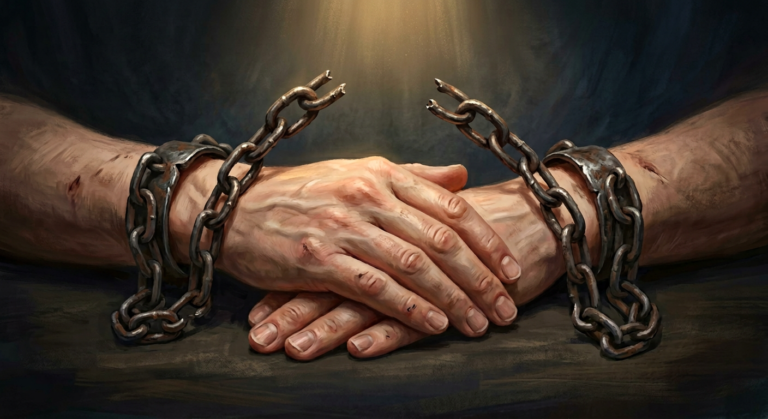
From a Nation Shackled in Chains to a Free People
It might have seemed that the wound of the past would never heal – that it lay too deep in the human heart for recovery to ever come.
After the era known to Poles as the lost generations (1772-1991), Poles once again began to trust, and to dream of something greater than freedom itself.
In 2004, after Poland joined the family of nations of the European Union, the United Kingdom opened its borders to the people of Poland.
Migration from Central Europe reached such intensity that many small towns in Poland became depopulated.
Poles arrived on the Islands in numbers that stirred social concerns among some communities in the United Kingdom – a natural reaction, for once a certain threshold is crossed, people begin to feel fear.
Yet the wave that swept through the Kingdom at that time also brought good things.
Poland was poor and plundered. Poles were hungry for a better life, ready to work seven days a week to change their fate.
They saw a chance to break free from the vicious circle that for centuries had weighed down and weakened their nation.
The money earned by those working on the Islands flowed into homes in Poland, like a wide river flowing into the ocean. It became one of the factors of Poland’s transformation – not the most important, but a vital link in the chain.
Thirty years after throwing off the chains of enslavement, Poland has transformed from a poor, backward country into a vibrant economy.
But that is not the most important part.
By welcoming Poles into their communities, the people of the United Kingdom opened the path to a shared future – to a new chapter in the history of the world of Islanders and Central Europeans.
The bridge built in so short a time is the achievement of the entire Islanders society.
Thanks to their heart and openness, Poles have become ambassadors of the Commonwealth family in Central Europe.
A Few Facts About Poland’s Transformation
The transformation of Poland’s economy after 1991 is considered one of the greatest economic success stories in the world.
Poland moved from a country struggling with hyperinflation and empty store shelves to the status of a developed economy (as classified by FTSE Russell since 2018).
1. GDP Growth Dynamics – Regional Leader
Poland has been the fastest‑growing economy in Europe over the past three decades.
• Poland vs the European Union: In 1990, Poland’s GDP per capita (PPP) was around 30% of the EU average; by 2024 it exceeded 80%. Poland has surpassed countries such as Greece and Portugal and is closing the gap on Spain.
• Avoiding recession: Poland was the only EU country to avoid a recession during the 2009 global financial crisis – the famous „green island”.
2. Comparison with Neighbours (Poland vs Ukraine)
In 1990 Poland and Ukraine had a similar GDP per capita (Poland ≈ USD 6,000; Ukraine ≈ USD 6,800 in PPP terms).
• Today: Poland’s GDP per capita has reached around USD 45,000 (PPP), while Ukraine’s – even before the full‑scale invasion of 2022 – hovered around USD 14,000. Poland’s economy has grown more than seven times faster over the same period.
3. Poland on the World Map
Globally, Poland is often compared to the „Asian Tigers” for its steady long‑term growth.
• Real GDP increase: Since 1990 Poland’s economy has expanded by more than 200%.
– Czech Republic and Hungary: ≈ 80-100%.
– Germany: ≈ 50-60%.
• Global ranking: Poland has risen from around 40th place to 21st in the world in nominal GDP (by 2024).
4. Visualising Growth (Cumulative GDP per Capita)
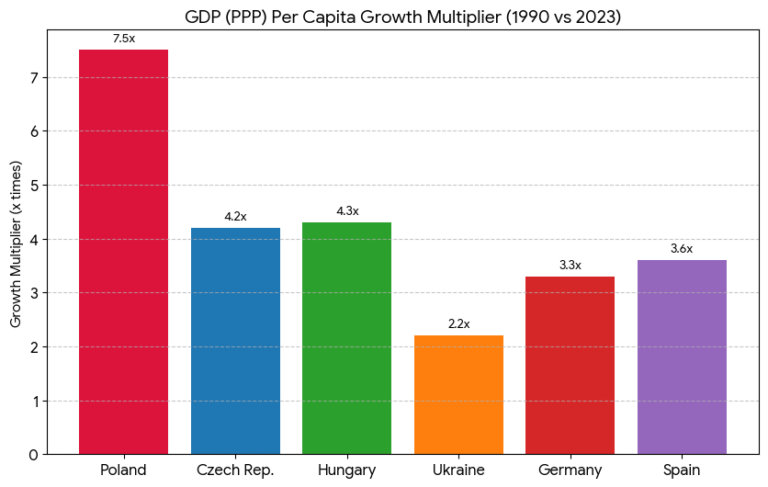
The chart above illustrates how Poland’s 7.5‑fold PPP growth outpaces other countries in the region and Western Europe during the same period.
Detailed comparisons of Poland’s GDP with other nations can be found in the World Bank Open Data and in IMF reports.