The Family of European Nations: A Path Through Truth to Healing
The family of nations within the European Union is a mosaic of many cultures, each with a vastly different history. Yet, they all accept the fact that the very name of this union comes directly from Greek culture – from the name of the Phoenician princess Europa, abducted by the Greek god Zeus. These times are so distant that they are steeped in myths and legends. However, it is worth remembering that this abduction also gave birth to a new life and a new civilisation. Just as in the physical world every birth is inextricably linked with a woman’s pain, the birth of Europe was paid for with centuries of suffering.
Since then, many cultures have washed over these lands. Some of them, like the Estonians or Latvians, carry the painful history of 700 years of subjugation. For centuries, they had to fight for biological survival because invaders deprived them of literally everything – even their children became the property of new masters.
Today, four great cultural traditions can be distinguished within the European Union, which have shaped its landscape:
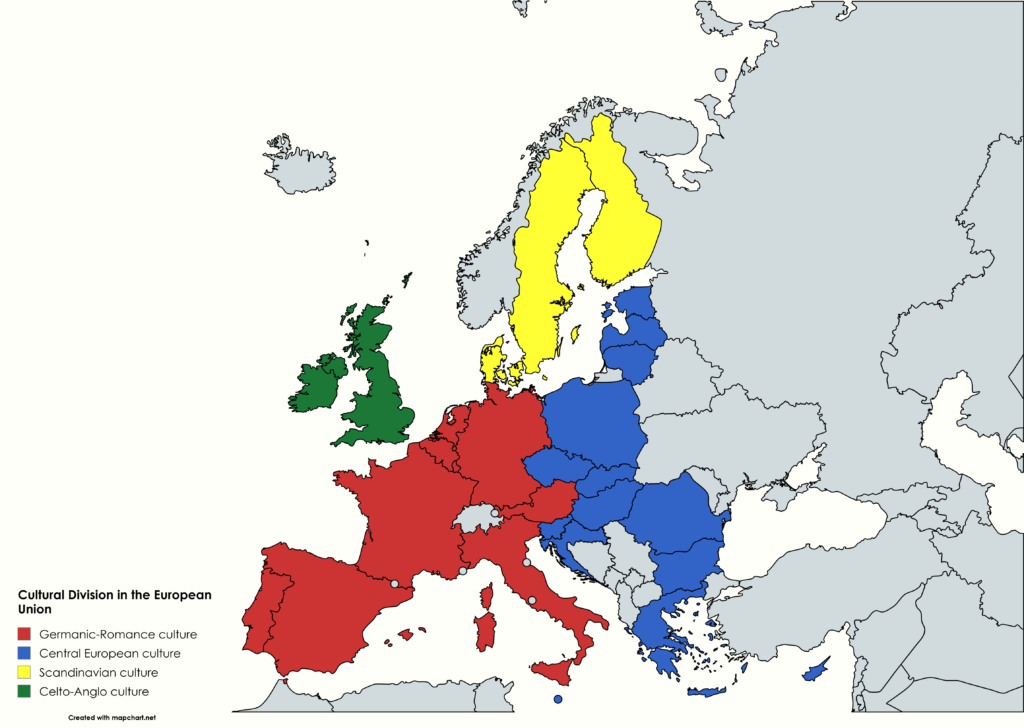
1. Germanic-Romance culture: It dominated the continent for a very long time. It was the representatives of this culture who established colonies on other continents, causing the average inhabitant of planet Earth today to consider Western European culture as synonymous with the entirety of European culture.
2. Central European culture: Having been under the occupation of empires for centuries (and in some cases, for thousands of years), with a predominance of Slavic peoples. It is from the name of this people, as a synonym for property, that the word „slave” originates in many Germanic-Romance languages (slaaf, sklave, esclave, esclavo, esclafe, etc. etc.). One thing unites Central European culture – centuries of subjugation and unyielding resistance against oppressors who tried to erase them from the pages of history. A striking, early example of this was already ancient Greece, robbed of everything by Rome, which even appropriated their gods.
3. Celtic culture: Which, over the centuries, was almost completely displaced from the continental part of Europe. Thousands of years ago, they were deprived of their land and influence. And yet, they survived the worst storms of history, showing others that empires ultimately fall, and the greatest value one should cherish is what one carries in their heart.
4. Scandinavian culture: Located in the northern regions of the family of European nations. Set apart from the main routes of great conflicts, it developed at a different, its own rhythm compared to the other cultures of the continent.
The nations originating from these four worlds decided to weave their fates into a single rope, despite everything that divides them so deeply. One group ruled and set the tone for hundreds of years, while the other was marginalised and ruled by that world.
Yet, the future of this union remains a challenge. The greatest source of uncertainty seems to be internal friction and a lack of understanding. The constant, subconscious imposition of their own history and viewpoint by representatives of the Germanic-Romance culture leads to an increasingly visible resistance in the central part of the continent.
Nations that for hundreds of years were deprived of a voice and had to obediently follow orders have finally felt what it truly means to be free. They discovered that in this new family, one can say the word „no” without facing the loss of life, torture, or long-term imprisonment.
On the other hand, nations from the Germanic-Romance area, accustomed to the historical obedience of others, find it immensely difficult to understand the unique status that the American tradition holds in Central Europe. They do not understand that it was precisely the involvement of the US after World War I that brought the long-awaited freedom to the Slavs and Baltic nations. It was the address of the United States that led to the collapse of the Austrian Empire, which had oppressed smaller nations for centuries. It was thanks to this impulse that Estonia, Latvia, Lithuania, and Poland could, after centuries of non-existence, become themselves again and be reborn as sovereign states. For Central Europe, the US opened an era of freedom.
The best examples illustrating this deep chasm in the understanding of history are the statements of two Western politicians. They show how deeply the Germanic-Romance culture fails to comprehend the experiences of its neighbours to the east:
– Guy Verhofstadt (Belgium): During a debate in the European Parliament in November 2017, commenting on the Warsaw Independence March – in which tens of thousands of ordinary citizens, veterans, and families with children participated to celebrate the gift of being free people – he used deeply stigmatising words. He declared from the podium that a march took place in Warsaw in which „60,000 fascists, neo-Nazis, and white supremacists” were walking.
This example clearly demonstrates a lack of historical empathy. This politician comes from a nation whose elites wrote tragic chapters in the history of colonial Congo. To people from his cultural circle, it seems that everyone in Europe shares the exact same guilt. They completely forget that in their own languages, the word „slave” derives from the times when Slavs were hunted, kidnapped, and turned into living commodities.
– Jacques Chirac (France): In February 2003, following the 11th of September attacks, Central European states supported the diplomatic and defensive actions of the US. Chirac, outraged that countries aspiring to European structures had their own opinion on foreign policy, uttered the famous, patronising words: „They missed a good opportunity to keep quiet.” He also added condescendingly that the behaviour of these states was „reckless” and „badly brought up.”
The President of France completely failed to understand that for the states of Central Europe, supporting the US was not a matter of „bad upbringing”, but of deep gratitude and loyalty towards the only power in history that helped them break imperial shackles. These words exposed a difference in the vision of the Union itself. For some, it was meant to be just another tool to maintain former spheres of influence and control over the weaker. For others, it became synonymous with authentic equality. An end to the centuries-long exploitation of one nation by another.
To understand today’s Europe, one must look at it through this double prism. The history of Estonia and Latvia is not the same as the history of Belgium or Germany.
The family of European nations still has a long way to go for the trauma lasting hundreds of years to find its release. Only when we stand in full truth and listen to each other’s stories will the energy of suffering and injustice accumulated over centuries be able to transform into the energy of true unity. Into the feeling that we are truly one and the same, mutually respecting family…