
The Shadow from the Depths
Jānis Pīnups (1925-2007)
Some flames do not require grand pyres to survive – a small, subterranean niche is enough, a place where the pure will to resist smoulders, invisible to the eyes of the world. Jānis Pīnups was born on 10 May 1925 in the idyllic parish of Pelēči, in the south-east of Latvia. He was just a young boy when the darkness of Soviet, and later Nazi, occupation stretched across his homeland. In August 1944, following the re-entry of the Red Army, Jānis was forcibly conscripted into the Soviet military and thrown onto the front lines. Yet, his conscience and his heart belonged to a free Latvia. After just a few weeks, amidst the bloody battles in the forests of Masuria, he made an uncompromising decision – he deserted and began his long journey on foot back to his family home.
For the first few months, he fought in the ranks of the national partisans, defending local residents from the terror of the NKVD. However, when the Soviet pacification noose tightened around the neck of the Latvian underground in the early 1950s, and most of his brothers-in-arms either perished or were sent to the gulags, Jānis had no intention of surrendering or begging for amnesties, which to a free man were nothing but humiliation. He chose a path that, to modern psychology, appears to be an insurmountable barrier. In 1945, he went underground and literally… vanished from the world of the living for over half a century. He became a lone wolf, turning to a deep, camouflaged pit dug beneath the floorboards of the barn and the attics of his family farm.
For fifty-one years, Jānis lived as an invisible shadow. While the Soviet Union built its atomic power, sent men into space, erected concrete cities, and terrorised half the planet, just a few inches beneath the floorboards, Jānis breathed the air of his forbidden homeland. A life in total isolation demanded superhuman discipline and nerves of steel. He knew that a single false step, a careless glance through a window, or a loud cough while strangers visited could mean a death sentence for him and immediate deportation to Siberia for his siblings, who secretly fed him and guarded his secret for decades. He possessed no documents, did not exist in any Soviet registries, and his neighbours were convinced that the young Pīnups had died on the front during the war.
This silent, darkness-shrouded resistance endured until the mid-1990s. Jānis did not break before the Soviet regime – he simply outlasted it, proving to be more durable than the totalitarian empire itself. He finally stepped out of the shadows and into the sunlight in 1995, at the age of 70. He only appeared at a government office of a free, independent Latvia once the last Russian occupation troops had definitively left his country’s soil.
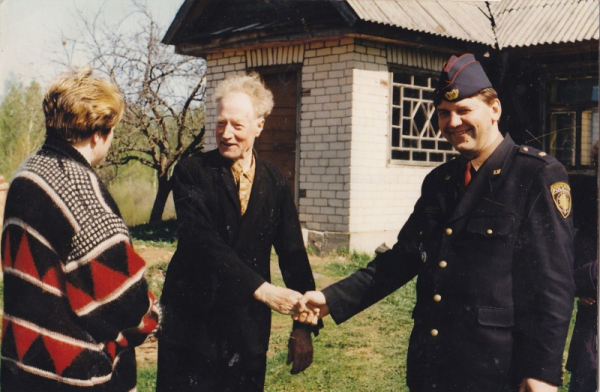
Jānis Pīnups (in the center) shaking the hand of a Latvian policeman after legalizing his situation in 1995 (Photo: Latvija20Gadsimts.lv)
Jānis Pīnups went on his eternal watch on 15 June 2007, living out his old age in a free homeland. He remains in memory as a symbol of a unique form of steadfastness – a wolf who proved to the world that an inner fire cannot be extinguished even in the deepest, darkest pit, and that silence and patience can outlive the greatest empires of evil.