
The She-Wolf of Resilience
„I am sad that I must die. Tell my grandmother that I acted as I should.”
– Danuta Siedzikówna „Inka” (1928-1946)
Some sparks are born in a body so young that their heat seems impossible, yet they can ignite a fire that no firing squad’s volley can ever extinguish. Danuta Siedzikówna was born on 3 September 1928 in the village of Guszczewina in the Podlasie region. She grew up in a world that collapsed almost overnight under the onslaught of two ruthless totalitarianisms. When she was just fifteen years old, her mother was executed by the Gestapo, and her father died of exhaustion after leaving a Soviet gulag. Yet, this orphan from the heart of war-torn Central Europe did not choose the path of fear. At the age of fifteen, she took her oath to the Home Army (Armia Krajowa), adopting the codename „Inka”, and entered service as a combat medic.
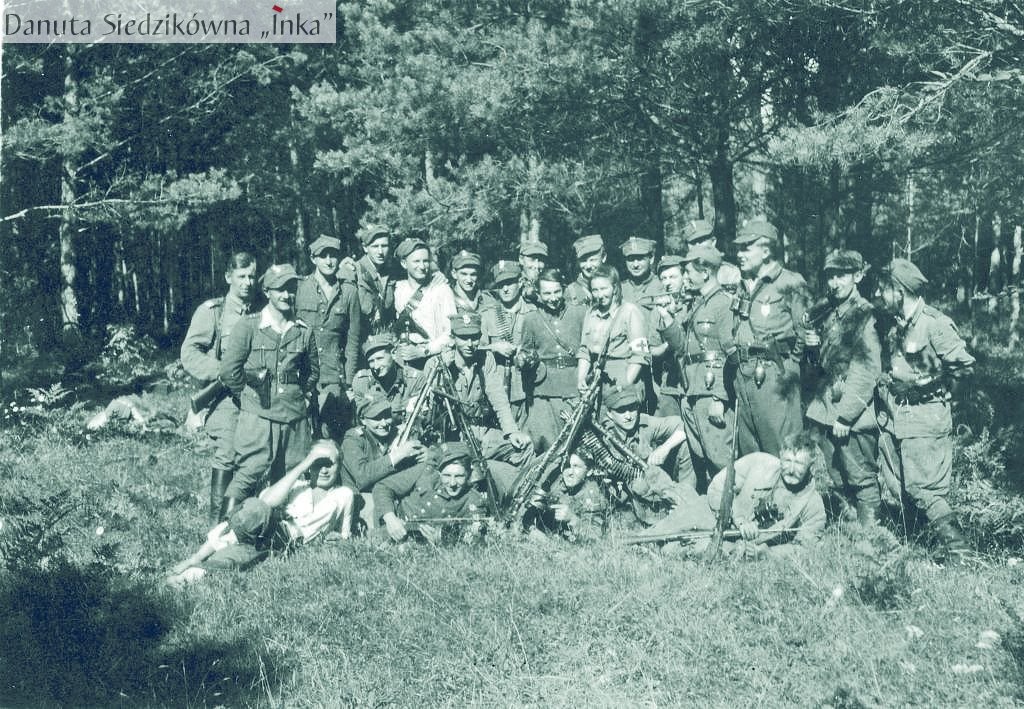
Soldiers of the 2nd and 4th Squadrons of the 5th Vilnius Home Army (AK) Brigade. „Inka” wearing an armband with a cross; Białystok region, summer 1945.
Following the passage of the Soviet front, as the new communist regime began a bloody manhunt for Polish patriots, „Inka” entered the ranks of the anti-communist underground. She served in the 5th Vilna Brigade of the Home Army. On forest trails and in field hospitals, she learned the hardest craft of all – saving the lives of her fellow brothers-in-arms under the watchful eye of Major Zygmunt Szendzielarz „Łupaszka”. She quickly became the very embodiment of unyielding loyalty. In a world that had lost all moral compasses, her compass became simple, soldierly honour.
The noose tightened on the night of 19/20 July 1946 in Gdańsk. Due to a betrayal, the seventeen-year-old girl fell into the hands of the communist secret police (UB). Locked away in the dark cells of the Gdańsk prison, she was subjected to a brutal interrogation. She was beaten, humiliated, threatened, and enticed with promises of freedom in exchange for just one thing: providing the addresses, names, and hiding places of her brigade members. Yet, „Inka” proved to be a barrier that the machinery of terror could not breach. She was like a young, wild she-wolf of resilience – her loyalty was so pure and unshakable that the legendary founders of Rome, Romulus and Remus, would have had no hesitation in nursing from a nature so indomitable. Despite the hell of her interrogations, she betrayed no one. Sentenced to death in a sham trial, she managed to secretly smuggle out a brief note from her cell, which became a testament of conscience for entire generations: „I am sad that I must die. Tell my grandmother that I acted as I should.”
On 28 August 1946, just six days before her eighteenth birthday, „Inka” stood before the firing squad. When the commander of the executioners wanted to blindfold her with a cloth, she refused. She wanted to look straight down the barrels. When the command „Fire!” rang out, a final, powerful cry erupted from her throat: „Long live Poland!”. The shots from ten rifles failed to kill her instantly – the wounded girl had to be finished off with a pistol shot by the officer overseeing the execution.
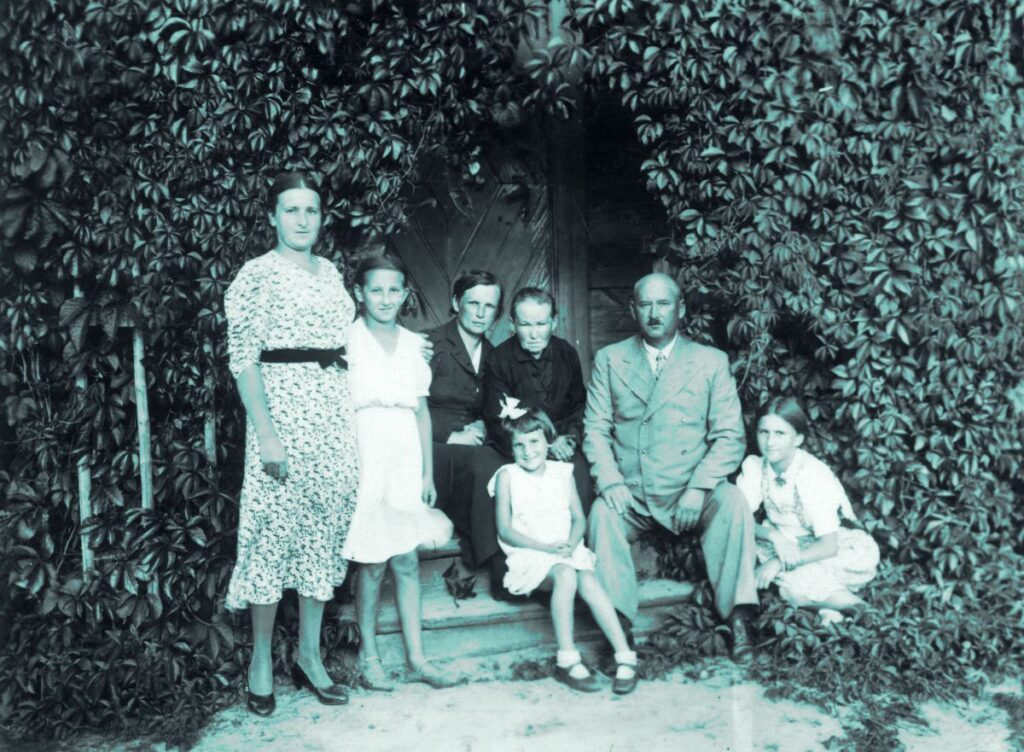
The Siedzik family. From left: Eugenia and Danuta are standing; Jadwiga and her mother Aniela are seated; in front of them is Wacław with his daughters—Irena (wearing a bow) on the left and Wiesława on the right; forester’s lodge in Olchówka near Narewka, summer 1939.
For nearly seventy years, the communist apparatus did everything in its power to erase her body and her memory from history, burying her secretly beneath paving slabs at the Garrison Cemetery in Gdańsk. It was only in September 2014 that her remains were unearthed, and genetic identification restored her to the world. Today, „Inka” rests with the highest state honours in a free land. She remains a universal symbol of moral victory – a she-wolf who proved to the world that an inner fire cannot be broken by torture, and that acting as one should is the only way to remain free, even in the face of death.